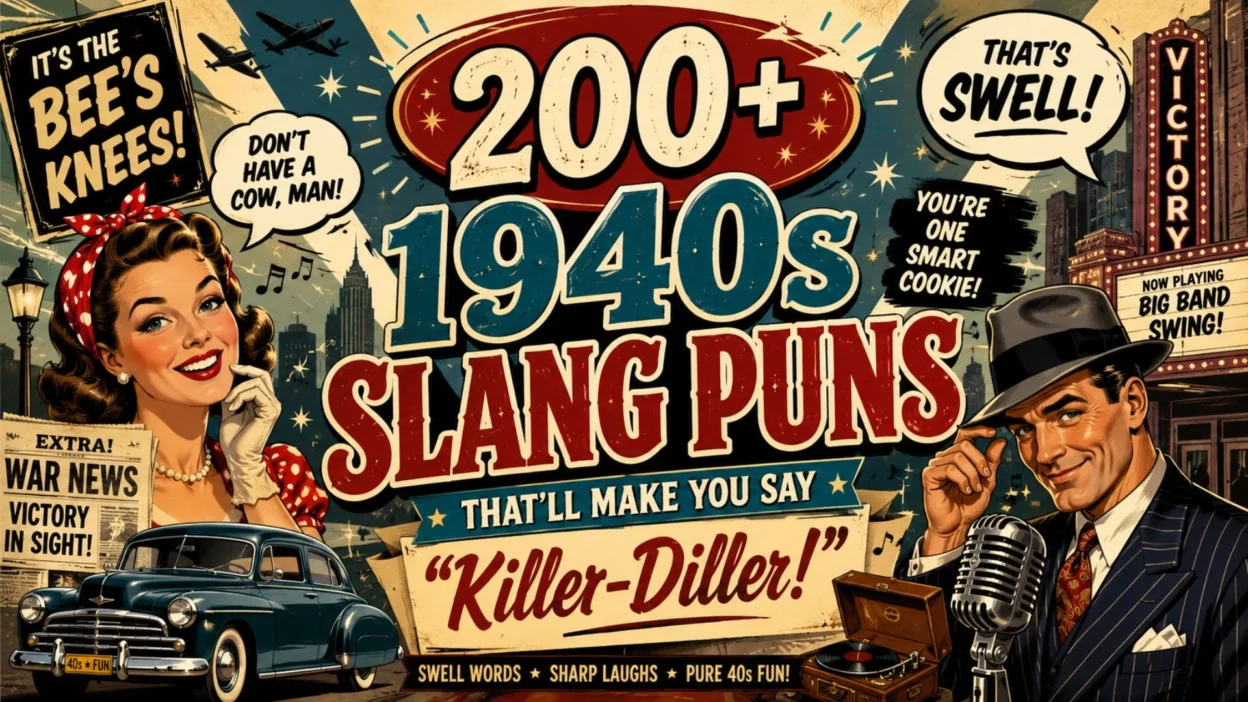
Picture this: It’s the 1940s. Big bands are swinging, bobbysoxers are swooning over Frank Sinatra, and somewhere in a diner, a jive bomber is ordering a cup of Joe while telling his doll she’s the cat’s meow. The world was at war, but the words were having a party.
1940s slang wasn’t just vocabulary—it was an attitude. It was whistling in the face of adversity, a way of saying, “Times are tough, but we’ve still got moxie.” And honestly? We could all use a little more of that energy today.
So grab your stompers, pour yourself some battery acid (that’s coffee, by the way), and get ready for a rib-tickling ride through the best 1940s slang—with a generous helping of puns, because why not? Whether you’re looking for caption gold, a clever bio, or just a good laugh, we’ve got you covered.
Let’s cook with gas! 🔥
🎯 Greetings & Catchphrases: “What’s Buzzin’, Cousin?”
The 1940s had some of the most creative greetings ever invented. Why say “hello” when you could say something way more interesting?
The Slang:
- “What’s buzzin’, cousin?” – What’s happening? How’s it going?
- “Hi sugar, are you rationed?” – Are you going steady?
- “Hi-de-ho!” – A jazzy way to say hello
- “Soitently!” – Certainly! (Popularized by Curly of the Three Stooges)
- “How’s the weather, heather?” – A rhyming greeting
The Puns (Because We Can’t Help Ourselves):
- “What’s buzzin’, cousin?” — Well, mostly the bees. They’re having a hive of a time. 🐝
- “Hi sugar, are you rationed?” — Because nothing says romance like wartime supply limits. “Sorry, honey, my heart’s not rationed—but my chocolate is.”
- “Soitently!” — The most confident way to say “yes” without actually committing to anything. “Are you sure?” “Soitently!” (Translation: I think so, but don’t quote me.)
- “How’s the weather, heather?” — It’s raining cats and dogs, and one of them is named Heather.
💃 Compliments & Cool Kids: “You’re the Cat’s Meow!”
If you wanted to tell someone they were awesome in the 1940s, you had options. And they were all wonderfully ridiculous.
The Slang:
- Cat’s Meow – Something splendid or stylish
- Killer-diller – The best; amazing
- Spiffy – Elegant appearance
- Swell – Wonderful
- Hotsy-totsy – Pleasing; just right
- Cook with gas – To do something right
- On the beam – On the right track; cool
The Puns:
- “You’re the cat’s meow!” — And I’m the dog’s bark. Together, we’re a paw-some duo.
- “That’s killer-diller!” — It’s so good, it kills me. And then dills me. Pickle puns, anyone? 🥒
- “Looking spiffy!” — You’re so sharp, you could cut through a ration line.
- “Now you’re cooking with gas!” — Finally! I was getting tired of cooking with drama.
- “Hotsy-totsy!” — The official word for “everything is just right”… except my dance moves.
🕺 Dance & Music: “Jive Bomber” and “Dead Hoofer”
Dancing was huge in the 1940s. Swing, jitterbug, Lindy Hop—if you couldn’t dance, you were basically invisible at parties.
The Slang:
- Jive bomber – A good dancer
- Hoofer – Dancer
- Ducky shincracker – A good dancer
- Dead hoofer – A poor dancer
The Puns:
- “He’s a real jive bomber!” — And his dance moves are explosive. (Sorry, I had to.)
- “She’s a ducky shincracker!” — Which sounds painful, but trust me, it’s a compliment.
- “Total dead hoofer.” — His feet have more sole than rhythm. 👟
- “Let’s cut a rug!” — Just don’t cut the carpet. The landlord will flip.
😂 Laughter & Fun: “That Cracks Me Up!”
The 1940s had some great words for fun and laughter. Because even in tough times, people found reasons to smile.
The Slang:
- Gas – A good time; something really funny
- Crack up – To burst out laughing
- Cracks me up – Makes me laugh
- Whoopee – To have a good time
The Puns:
- “That was a real gas!” — I’m fuming with laughter! (Okay, that one’s a stretch. But I’m committed.)
- “That cracks me up!” — Like an egg. Over easy. With a side of giggles. 🍳
- “Let’s make whoopee!” — Not like that—I mean let’s dance! Get your mind out of the gutter!
💔 Romance & Crushes: “Carrying a Torch”
Love in the 1940s was dramatic, heartfelt, and full of colorful expressions.
The Slang:
- Carry a torch – To have a crush on someone
- Stuck on – Having a crush
- Doll dizzy – Girl Mistaken
- Khaki wacky – Boy Mistaken(especially for men in uniform)
The Puns:
- “I’m carrying a torch for you.” — And it’s burning a hole in my pocket. 🔥
- “He’s doll dizzy!” — Someone call a doctor. Or a dance instructor.
- “She’s khaki wacky!” — She sees a uniform and loses all self-control. (Relatable.)
- “I’m stuck on you.” — Like glue. Or gum on a shoe. Either way, you’re not getting rid of me.
💰 Money & Work: “Pennies from Heaven”
The 1940s economy was… complicated. But the slang for money was anything but boring.
The Slang:
- Pennies from heaven – Easy money
- Lettuce – Paper money
- Dough – Money
- Do-re-mi – A pun on dough
- Brainchild – Someone’s creative idea
- Eager beaver – Enthusiastic helper
The Puns:
- “Pennies from heaven!” — Finally, my prayers are answered. And they’re made of copper.
- “Pass the lettuce!” — I’m not making a salad, I’m asking for cash. 🥬
- “Where’s the dough?” — In the oven. Oh wait, you meant money.
- “Nice brainchild!” — Your idea is so good, it should have a godparent.
- “Total eager beaver!” — This person is so enthusiastic, they’d build a dam if you asked.
😤 Insults & Frustrations: “Don’t Flip Your Wig!”
Even the insults were more creative back then. Why call someone foolish when you can call them a fat-head?
The Slang:
- Fat-head – foolish or foolish person
- Chicken – Coward
- Chrome-dome – Bald man
- Flip your wig – Lose control of yourself
- Snap your cap – Get angry
- Bum rap – False accusation
- Bust your chops – Scold or yell at someone
The Puns:
- “Don’t be a fat-head!” — Your head’s not fat, it’s just… intellectually overstuffed.
- “Don’t flip your wig!” — It took me hours to style this. 💇
- “Snap your cap?” — That’s not a hat, that’s your temper.
- “That’s a bum rap!” — And I’m not talking about a bad song. 🎵
- “Don’t bust my chops!” — My chops are fine, thank you very much.
🚶 Leaving & Escaping: “Take a Powder!”
Sometimes you just need to leave. The 1940s had stylish ways to say “I’m out.”
The Slang:
- Take a powder – To leave quickly
- Scram – Ask someone to leave immediately
- Spread out! – Get out of the way!
- Vamoose – To leave (adopted from Spanish)
The Puns:
- “Time to take a powder!” — I’m not doing makeup, I’m escaping. 💨
- “Scram!” — As in scrambled eggs. As in get out of my kitchen.
- “Spread out!” — Like butter. On toast. Move.
- “I’m vamoosing!” — It’s not a moose. It’s a departure.
☕ Food & Drink: “Armored Heifer” and “Battery Acid”
Wartime rationing meant food was scarce, but the slang for food was rich.
The Slang:
- Armored heifer – Canned milk
- Battery acid – Coffee (Army slang)
- Hen fruit – Eggs
- Joe – Coffee
The Puns:
- “Pass the armored heifer!” — Because regular cows are too vulnerable.
- “Pour me some battery acid.” — Just how I like my coffee: corrosive.
- “Hen fruit for breakfast!” — They’re eggs. Just say eggs.
- “Cup of Joe?” — Joe who? Oh, coffee Joe. Got it. ☕
👔 People & Characters: “Geezer” to “Wise Guy”
The 1940s had a type for everyone.
The Slang:
- Geezer – An old person
- Dame – A woman
- Broad – A woman (informal)
- Wise guy – A smart aleck
- Moll – A gangster’s girl
- Hard boiled – A tough, strong guy
The Puns:
- “He’s a geezer.” — Not to be confused with a geyser. One erupts. The other… also erupts, but with complaints.
- “She’s a classy dame.” — And she knows it. 👒
- “Don’t be a wise guy.” — Unless you want a knuckle sandwich.
- “Total hard-boiled.” — Like an egg. But with attitude. 🥚
🎭 The Rhyming Slang Hall of Fame
The 1940s loved rhymes. The sillier, the better.
The Slang:
- “You know what I mean, jelly bean?” – Do you understand?
- “What I said, cabbage head.” – A rhyming retort
- “Don’t get hot, coffeepot.” – Calm down
- “Don’t get mad, Alan Ladd.” – Don’t get angry
- Fuddy-duddy – Old-fashioned, stuffy person
- Gobbledygook – Confusing, nonsense language
The Puns:
- “You know what I mean, jelly bean?” — Yes, and I’m sweet on you. 🍬
- “What I said, cabbage head.” — Are we trading vegetable insults now?
- “Don’t get hot, coffeepot.” — I’m not hot, I’m percolating.
- “Don’t get mad, Alan Ladd.” — I’ll try, but no promises.
- “Total fuddy-duddy!” — He’s so old-fashioned, he thinks radio is new technology.
- “That’s gobbledygook!” — It’s not gobble. It’s gook. I think. Honestly, I’m confused too.
🌟 Bonus Round: Even More 1940s Slang Puns!
Because you can never have too much of a good thing.
The Slang:
- Ameche – To make a phone call (from actor Don Ameche)
- Moxie – Courage; nerve
- Rhubarb – An argument or squabble
- Pass the buck – Shift responsibility
- Grandstand – To show off
- Stompers – Shoes
The Puns:
- “I’ll Ameche you later!” — Not reach. Ameche. It’s a call, get it? 📞
- “She’s got moxie!” — And she’s not afraid to use it.
- “They’re having a rhubarb.” — I thought it was a pie filling. 🥧
- “Stop passing the buck!” — This isn’t a deer farm.
- “Quit grandstanding!” — The bleachers are over there.
- “Nice stompers!” — They’re great for stomping… and walking.
💡 How to Use 1940s Slang Like a Pro
So you’ve got the vocab. Now what? Here’s how to sprinkle these gems into your daily life:
📱 Social Media Captions:
- “Feeling spiffy today! ✨ #VintageVibes”
- “That’s killer-diller! 🔥”
- “What’s buzzin’, cousin? 🐝”
💬 Text Messages:
- “You know what I mean, jelly bean?”
- “Don’t flip your wig—I’ll be there in 5.”
👤 Bios:
- “Professional eager beaver. Amateur jive bomber.”
- “Carrying a torch for good coffee and bad puns.”
🎉 Party Starters:
- Walk in and say “What’s buzzin’, cousin?” to everyone.
- Call the DJ a “jive bomber.”
✍️ Creative Writing:
- Add 1940s slang to dialogue for instant period flavor.
- Use “gobbledygook” to describe confusing emails.
The key is confidence. Say it like you mean it, and people will love it.
🧠 Why 1940s Slang Still Matters
You might be wondering: Why should I care about words from 80 years ago?
Here’s the thing—language is alive. The slang of the 1940s tells us something about the people who used it. They were facing a world war, rationing, and uncertainty. And yet, they chose to say “What’s buzzin’, cousin?” instead of “How are you?” They chose playfulness over despair.
That’s moxie. That’s resilience.
And honestly? We could use a little more of that today. So next time life gets heavy, channel your inner 1940s spirit. Flip your wig (metaphorically). Cook with gas. And remember: even in tough times, there’s always room for a good pun.
🎤 Your Turn: Share Your Favorite!
Now it’s your turn, cousin!
Which 1940s slang term tickles your funny bone the most? Are you a “jelly bean” enthusiast? A proud “eager beaver”? Or do you just love calling people “fat-head” (affectionately, of course)?
Drop your favorite in the comments! And if you’ve got a pun we missed, share that too. Let’s keep this vintage party going.
And remember: Don’t get hot, coffeepot. It’s all in good fun. 😉
❓ FAQ: 1940s Slang Edition
Q: What exactly is 1940s slang?
A: 1940s slang refers to the informal words and phrases that were popular during the 1940s, particularly in the United States. Many terms came from the military during World War II, while others emerged from jazz culture, Hollywood, and everyday life. Examples include “killer-diller” (amazing), “gas” (fun), and “what’s buzzin’, cousin?” (how’s it going?).
Q: Why did people use so much slang in the 1940s?
A: The 1940s were a time of huge stress—World War II, rationing, uncertainty. Slang was a way of “whistling in the face of adversity”, a coping mechanism that brought humor and camaraderie. It also reflected the era’s vibrant music and youth culture. Basically, people needed to laugh, and slang gave them a reason to.
Q: Can I still use 1940s slang today?
A: Absolutely! Many terms like “eager beaver” and “chicken” are still in use. Others are making a comeback thanks to vintage trends on social media. Just be prepared for confused looks if you call someone a “chrome-dome” or ask “what’s buzzin’, cousin?” But hey, that’s part of the fun!

I am a U.S.-based writer with a love for clever wordplay, lighthearted humor, and creative storytelling. She enjoys exploring the fun side of language and believes that even a simple sentence can make someone smile. When she’s not writing, Lily can be found reading short stories, sipping iced coffee, or collecting new puns for her notebook.