Picture this: You’re scrolling through TikTok, and someone comments, “That’s cap.” You look down. You’re not wearing a hat. You look around. No one’s holding a baseball cap. Confusion sets in. What does cap mean slang? Did you miss a memo? Are hats secretly involved in some kind of internet conspiracy?
Relax. Take a deep breath. Put down the hat.
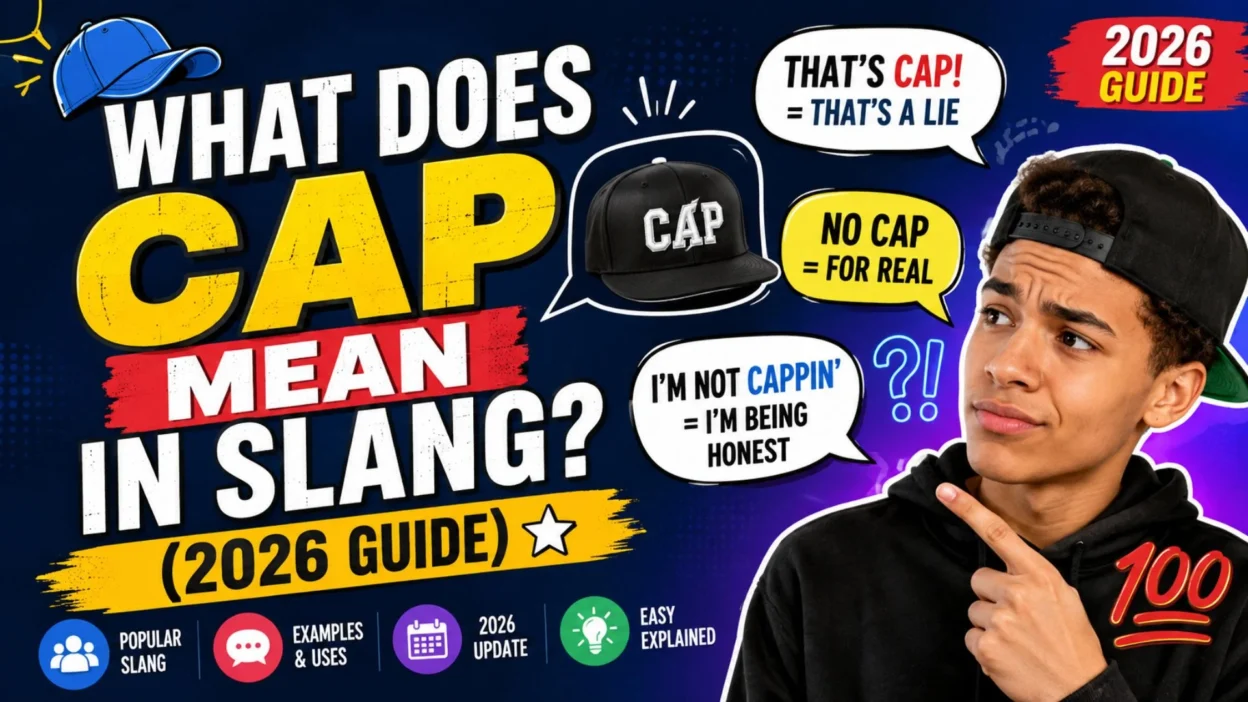
In the wild, wonderful world of internet slang, “cap” means a lie—something false, exaggerated, or just plain not true. And “no cap”? That means “no lie,” “for real,” or “I’m being completely serious”.
Think of it this way: If your friend tells you they can eat fifty hot dogs in one sitting, and you know that’s absolutely ridiculous, you’d say, “That’s cap.” If you actually did eat fifty hot dogs (and you have the trophy to prove it), you’d say, “No cap, I really did it.”
Simple, right? Well, not exactly. Because as with all good slang, there’s history, there’s nuance, and there are plenty of opportunities for puns. And if there’s one thing we love more than learning new words, it’s making terrible jokes about them.
So grab your favorite beverage, put on your thinking cap (see what I did there?), and let’s dive into the wonderfully weird world of “cap” slang. No cap—this is going to be fun.
🎯 What Does “Cap” Mean in Slang? The Short Answer
Let’s start with the basics before we get punny.
In modern slang, “cap” means a lie, a falsehood, or an exaggeration. It can be used as:
- A noun: “That story is cap.”
- A verb: “Stop capping, bro.”
- An accusation: “You’re capping right now.”
On the flip side, “no cap” means “no lie,” “for real,” or “I’m being totally honest”. It’s the verbal equivalent of a pinky promise—except way cooler and with zero pinkies involved.
Quick cheat sheet:
PhraseMeaningExampleCapA lie or exaggeration“You met Drake? That’s cap.”No capNo lie; for real“No cap, that pizza was amazing.”CappingLying or exaggerating“He’s capping about his grades.”That’s capThat’s a lie“You ran a four-minute mile? That’s cap!”
See? Easy peasy. Now let’s get to the good stuff—the puns.
😂 15 Hilarious “Cap” Puns That’ll Make You Laugh (No Cap!)
Here’s where things get fun. If you’re going to use “cap” in your daily vocabulary, you might as well have some puns ready to go. These are clean, family-friendly, and guaranteed to make your friends either laugh or groan. (Both are acceptable reactions.)
🧢 The Hat Puns (Because Obviously)
- “I told my friend I was wearing a cap. He said, ‘That’s cap.’ I said, ‘No cap—literally, look at my head.’”
- “Why did the baseball cap go to therapy? It had too many issues with capping.”
- “My hat collection is impressive—no cap.”
- “I bought a new cap today. My friend said, ‘That’s cap.’ I said, ‘It’s literally on my head.’”
- “What did the cap say to the hat? ‘Stop capping—you know I’m the original.’”
📱 Social Media Puns
- “My Instagram feed is full of lies. That’s cap-tivating content.”
- “She said she has a million followers. I said, ‘That’s cap.’ She said, ‘No cap—check my page.’”
- “Why did the influencer get canceled? Too much capping.”
- “My DMs are full of cap—and I don’t mean hats.”
- “No cap, this meme is the funniest thing I’ve seen all week.”
🍕 Food Puns (Because Everything’s Better with Food)
- “This burger is the best I’ve ever had—no cap. And yes, I mean the burger, not a hat.”
- “My friend said he could eat a whole pizza by himself. That’s cap. He barely finished two slices.”
- “No cap, this coffee is life-changing. And I’m not even exaggerating.”
- “She said her cake was better than mine. That’s cap—and I have the taste buds to prove it.”
- “I told the waiter the soup was delicious. No cap—it was souperb.”
📖 Where Did “Cap” Slang Come From? (A Quick History Lesson)
Now that we’ve had our fun, let’s get a little educational. Because knowing where words come from makes you sound smarter at parties. (No cap.)
The slang meaning of “cap” actually goes way back—much further than TikTok or even the internet itself.
The 1500s: The Very First “Capping”
Believe it or not, the roots of “capping” stretch all the way back to the 1500s! Back then, “to cap” meant to outdo someone in a verbal jousting game—like telling a better joke or sharing a more impressive quote. People would “cap” each other’s anecdotes, trying to have the last and best word.
The 1800s: Competitive Storytelling
By the 1800s, “capping” had evolved into a way of competing by telling better jokes or stories than someone else. Think of it as the original roast battle—just with fewer microphones and more top hats.
The 1940s: Enter African American Vernacular English (AAVE)
By the 1940s, Black Americans were using “to cap” when trading exaggerated insults in a ritualized verbal game known as “the dozens”. In this context, “capping” meant “stretching the truth” or “exaggerating”.
The 1980s–2010s: Hip-Hop Takes Over
“Cap” as slang for “lie” really took off in hip-hop culture. The first recorded instance of “capping” in song lyrics appears in a 1985 EP from California rapper Too Short. Variations of the term appeared in rap songs throughout the next few decades.
Then came 2017, when Atlanta rappers Future and Young Thug released the track “No Cap.” The phrase exploded in popularity, and suddenly everyone was saying “no cap” and “that’s cap”.
2018–Present: Mainstream Madness
By 2018, “no cap” had entered the mainstream. Urban Dictionary’s first entry for “no cap” appeared that year, and soon the term was everywhere—from social media to memes to everyday conversations.
Today, “cap” and “no cap” are core parts of Gen Z and internet language. They’re short, punchy, and endlessly versatile—just like the people who use them.
💬 How to Use “Cap” and “No Cap” Like a Pro (With Examples!)
Ready to start using “cap” like a true slang connoisseur? Here’s your ultimate guide:
👎 When to Use “Cap” (Calling Out Lies)
Use “cap” when you think someone is exaggerating or straight-up lying:
- “You got an A+ without studying? That’s cap.”
- “He said he can bench press 300 pounds. Major cap.”
- “She claims she’s never watched a single Marvel movie. Cap.”
👍 When to Use “No Cap” (Emphasizing Honesty)
Use “no cap” when you want to stress that you’re being 100% truthful:
- “No cap, this is the best song I’ve ever heard.”
- “I finished the whole project in one night. No cap.”
- “No cap, I’m actually serious about learning this slang.”
🔄 When to Use “Capping” (The Verb Form)
Use “capping” to describe someone in the act of lying:
- “Stop capping—I know you didn’t meet that celebrity.”
- “Why are you capping right now? Just be honest.”
- “He’s been capping all day about his new job.”
🎯 When to Use “That’s Cap” (The Classic Comeback)
This is the ultimate “I don’t believe you” response:
- “I can eat 20 tacos in one sitting.” “That’s cap.”
- “My dad invented the internet.” “That’s cap.”
- “I once wrestled a bear.” “That’s cap.”
🎭 The Cap Emoji: Because Words Aren’t Enough
If you spend any time on social media, you’ve probably seen the blue billed cap emoji () being used in comments. Here’s the deal: that emoji has become a visual shorthand for “cap” slang.
- Seeing a wild claim on TikTok? Drop a in the comments.
- Want to say “no cap” without typing it? Use 🧢.
- Calling out a friend’s exaggeration? Throw a or two their way.
It’s efficient, it’s fun, and it saves you precious typing time. What’s not to love?
🧢 10 More “Cap” Puns to Use in Captions, Texts, and Conversations
Because you can never have too many puns. Here are ten more to add to your collection:
- “No cap, this outfit is fire.” (Use for a fashion post.)
- “That’s cap-tivating content right there.” (For your best Instagram photo.)
- “Don’t cap my vibe.” (When someone’s bringing negativity.)
- “Cap or no cap? You decide.” (For controversial opinions.)
- “I’m the cap-tain of my own destiny.” (Inspirational, with a pun.)
- “That story was cap-tastic… and by that I mean full of lies.”
- “No cap, just facts.” (The perfect caption for truth-telling.)
- “Stop capping and start living.” (Motivational and slangy.)
- “Cap-tain Obvious here—that’s clearly a lie.”
- “No cap, this is my new favorite word.” (For when you’ve officially adopted “cap” into your vocabulary.)
🌟 Pro Tips: How to Use “Cap” Slang Like a Native Speaker
Want to sound like you’ve been using “cap” your whole life? Follow these tips:
- Context Is Everything – “Cap” works best in casual, informal settings. Use it with friends, on social media, or in texts. Probably not the best choice for a job interview or a formal email. (Unless you’re applying to be a professional slangologist. Then go for it.)
- Tone Matters – Say “that’s cap” with a smile or a laugh. It’s usually playful, not aggressive. Think of it as friendly teasing rather than a serious accusation.
- Mix It Up – Don’t overuse it. Sprinkle “cap” and “no cap” into your conversations like seasoning—just enough to add flavor, not so much that it overpowers everything else.
- Embrace the Emoji – The blue cap emoji () is your friend. Use it liberally in texts and comments. It’s the modern-day equivalent of a knowing wink.
- Have Fun With It – Slang is meant to be enjoyable. Don’t stress about getting it perfect. The more you use it, the more natural it’ll feel. No cap.
❓ Frequently Asked Questions About “Cap” Slang
Q: What does “cap” mean in slang?
A: In slang, “cap” means a lie, an exaggeration, or something that’s not true. It’s used to call out false statements or to describe someone who’s not being honest. For example: “He said he has a pet tiger—that’s cap.”
Q: What does “no cap” mean?
A: “No cap” means “no lie” or “for real”. It’s used to emphasize that you’re being completely honest and serious about something. For example: “No cap, this is the best movie I’ve ever seen.”
Q: Where did “cap” slang come from?
A: The slang use of “cap” originated in African American Vernacular English (AAVE) and dates back to at least the early 1900s. It was popularized through hip-hop culture and went mainstream in the late 2010s, largely thanks to rappers like Future and Young Thug. The term actually has roots going back to the 1500s, when “capping” meant outdoing someone in verbal jousting.
Q: Is “cap” slang still popular?
A: Yes! “Cap” and “no cap” have become core parts of Gen Z and internet language. They’re used widely on social media platforms like TikTok, Instagram, and Twitter, and they show no signs of disappearing anytime soon.
Q: Can I use the cap emoji () to mean “cap” slang?
A: Absolutely! The blue billed cap emoji has become a popular visual shorthand for “cap” slang. People use it in comments and texts to call out lies or to say “no cap.” It’s quick, fun, and universally understood by internet-savvy folks.
🎉 Conclusion: No Cap, You’re Now a Slang Expert!
And there you have it—everything you ever wanted to know about “what does cap mean slang,” wrapped up in a fun, pun-filled package.
Let’s recap:
- “Cap” = a lie or exaggeration.
- “No cap” = no lie, for real, I’m being serious.
- “Capping” = the act of lying.
- “That’s cap” = that’s a lie, I don’t believe you.
You’ve learned the history, mastered the usage, and collected enough puns to last a lifetime. You’re ready to navigate the wild world of internet slang with confidence, humor, and maybe a few eye-rolls from your friends.
So go forth and use your new knowledge wisely. Call out cap when you see it. Drop a “no cap” when you’re being real. And always, always remember: learning slang should be fun—no cap.
Now it’s your turn! What’s your favorite “cap” pun? Have you ever caught someone capping in the wild? Drop your best examples in the comments below. We’d love to hear from you—no cap!
Enjoyed this article? Share it with a friend who needs to know what “cap” means. And don’t forget to subscribe for more fun, family-friendly language guides!

I am a U.S.-based writer with a love for clever wordplay, lighthearted humor, and creative storytelling. She enjoys exploring the fun side of language and believes that even a simple sentence can make someone smile. When she’s not writing, Lily can be found reading short stories, sipping iced coffee, or collecting new puns for her notebook.